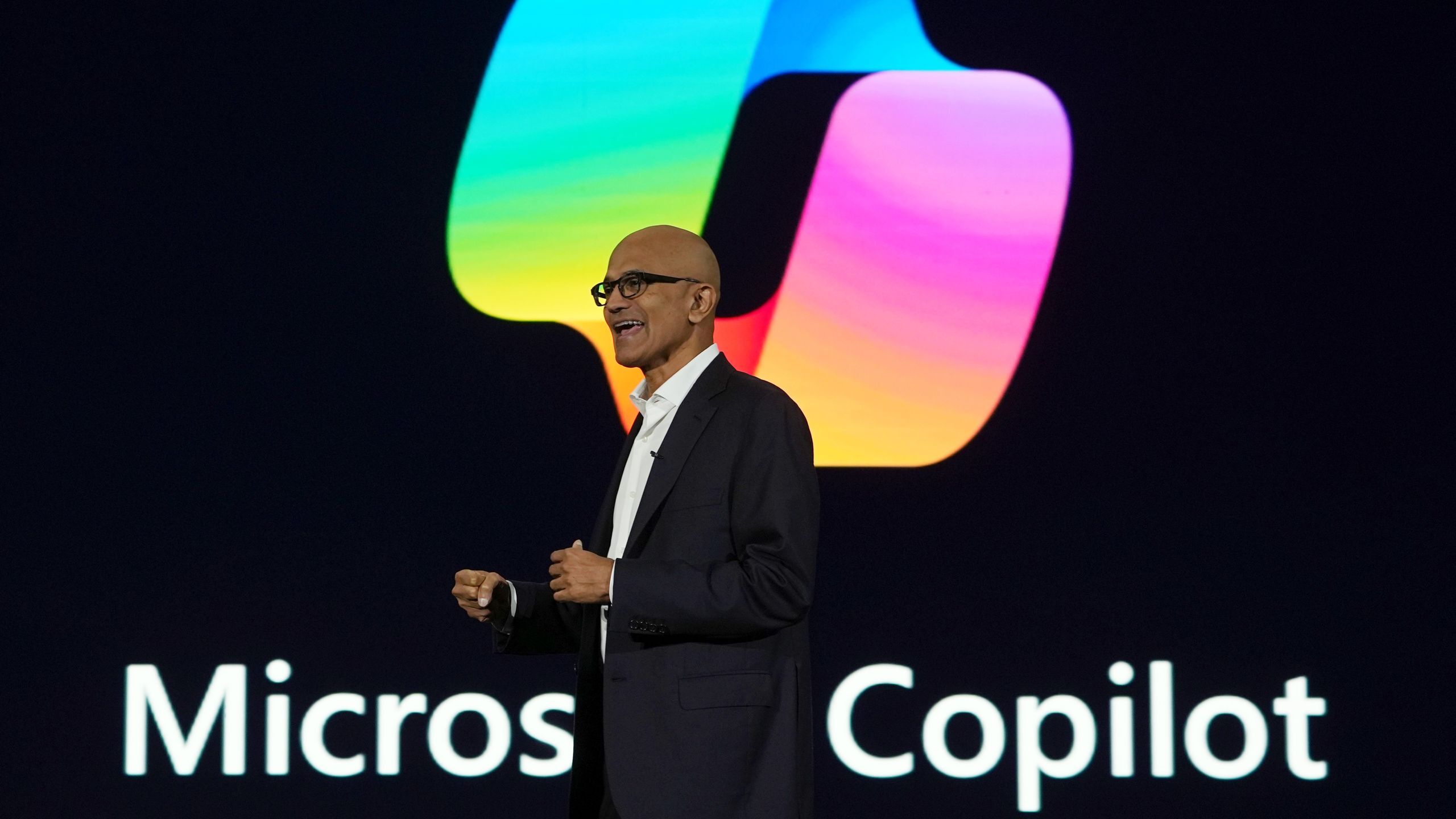
“Let’s not call it what it is, but what I want you to believe it is because money”
He wants everyone to become
prompt engineerssloperators.SLOPERATOR, thanks for this hahaha
Word of the year!
I love this term! It’s been added to my active lexicon!
Nadella, go ahead, keep trying to meet your slop metrics and slop KPIs. You’re doing a great job moving people to Linux.
another rich person telling us what to do
AI slop AI slop AI slop AI slop AI slop AI slop AI slop AI slop AI slop AI slop AI slop AI slop AI slop AI slop AI slop
I’m seriously thinking of becoming a luddite.
Whatever you say, Slopya Nadella. Shit someone already made that joke.
Slop goes the AI bubble.
Windowscentral does this on leaving:

That’s why, here’s the story (useless gunk and site links removed):
Microsoft CEO Satya Nadella really wants you to stop calling AI “slop” in 2026 — “We are beginning to distinguish between spectacle and substance.”
In closing comments of 2025, Microsoft CEO Satya Nadella shared an update on the company’s mindset for 2026 — shocker, it’s all about AI.
The fact my first article of 2026 is about artificial intelligence is probably tone-setting for what will be another year dominated by AI news and headlines.
It’s hard to avoid right now, particularly if you’re a user of Microsoft ecosystem products. Every single app, service, and product Microsoft has on the market now has some kind of AI integration, regardless of quality and usefulness.
Microsoft Copilot is the tip of the spear for the firm, powered entirely by ChatGPT and Microsoft’s early investments in OpenAI. Its interface is pre-installed now on Windows PCs, and has a commanding position on most mobile app stores as of writing. It’s nowhere near as widespread as OpenAI’s ChatGPT service, though, and advancements in Google Gemini sees Microsoft’s old arch rival rapidly outpacing the competition — particularly in enterprise integrations, where Microsoft has its sights primarily set.
The oft-forced, oft-useless Microsoft Copilot integrations on Windows and other consumer products have people exploring alternatives more so than ever before. Entire governments are abandoning Windows for Linux, and there’s more interest in Linux consumer-grade distros than any time I can remember. Despite the noise about the degradation of quality in Windows, the price gouging on Xbox, and the apparent abandonment of Surface — Microsoft CEO Satya Nadella made no mention of any of them in a recent post (via LinkedIn) to close out the year.
If you had any illusion that Microsoft might address concerns about any of its major product categories in 2026, Nadella’s “Looking Ahead to 2026” article offers an insight into the company’s focus for the new year, and yep, it’s all about AI.
“As I reflect on the past year and look toward the one ahead, there’s no question 2026 will be a pivotal year for AI. Yes, another one” Nadella opines. “But this moment feels different in a few notable ways.”
“We have moved past the initial phase of discovery and are entering a phase of widespread diffusion. We are beginning to distinguish between “spectacle” and “substance”. We now have a clearer sense of where the tech is headed, but also the harder and more important question of how to shape its impact on the world.”
Nadella is, of course, correct that AI is becoming ubiquitous. Some estimates suggest that AI tools are used daily by upwards of a billion people, and it will only continue to rise in the coming year. I’m not sure I agree that it’s moving beyond its “spectacle” phase. AI discourse continues to to be dominated by memes, disinformation, hallucinations, and a near-total, and potentially dangerous lack of profitability. Multiple billions of dollars in ethereal commitments, often described as the “AI bubble,” has many leading economists nervous.
Nadella also claims in the piece that AI will be a “scaffolding” for human potential, rather than a substitute. I can’t help but think this is either naively utopic, or at worse, wilfully dishonest. The vast rush of AI investment revolves entirely around Wall Street’s hunger for automation — replacing “expensive” humans with cheap robots and facsimiles. Microsoft itself laid off tens of thousands last year, while boasting 30% of its code was now being written by AI. It certainly hasn’t led to a visible increase in productivity, quality, or customer satisfaction.
Still, Nadella claims that we’ll move away from “models” to “systems” that lead to real world impact in 2026, noting that it will require “engineering sophistication” to find AI’s real world value. At a reach, I can only hope this means Microsoft’s AI features in Windows will evolve to actually become useful. Today you need prompt engineering expertise or custom tools to make Copilot even vaguely useful at home, even before you consider having to fact-check everything it claims. Features that should be simple like generative editing in Microsoft Photos or generating subtitles in Microsoft Clipchamp straight up don’t work.
Indeed, in closing, Nadella seems to admit that AI doesn’t truly have “societal permission” right now, referencing widespread backlash and mockery that continues to dog the technology.
“We need to get beyond the arguments of slop vs sophistication,” Nadella laments, emphasizing hopes that society will become more accepting of AI, or what Nadella describes as “cognitive amplifier tools.” “…and develop a new equilibrium in terms of our “theory of the mind” that accounts for humans being equipped with these new cognitive amplifier tools as we relate to each other.”
There is research that AI use may actually harm cognitive ability by the way. But I digress.
AI is important for the company’s future — but the hyper-fixation is almost weird.
“We need to make deliberate choices on how we diffuse this technology in the world as a solution to the challenges of people and planet,” Nadella says. “For AI to have societal permission it must have real world eval impact.”
I’m not sure if it’s cynicism on my part, I constantly question myself with regards to discussions on this tech, but Nadella once again comes across as naïve here. And it reminds me of his fling with the “Metaverse” of previous years — another tech buzzword buried in the graveyard of overhype alongside things like NFTs and LaserDisc.
If you go back and listen to Satya Nadella’s comments on “the metaverse” from just a few years ago, you’ll see what I mean. It was all about holograms, heads-up displays, and other products that ultimately went nowhere. A cloud of fluffy technobabble and utopic thinking — that served only to trick investors into thinking Microsoft was at least somewhere on the curve.
Of course, now we know it was as unreal as the holograms themselves. Even Apple failed here, scaling back production of its ridiculous Vision Pro headsets. Facebook, who literally rebranded its company to Meta for this, is also sacrificing its VR aspirations on the pyre of AI to the tune of wasted billions. To Microsoft’s credit, it hardly went all in, likely sensing that it was set to be a fad. But it certainly doesn’t seem to be treating AI with the same sense of caution.
Nadella has shown himself to be an incredibly savvy businessman, playing Wall Street with confident utopic promises atop a roaring and seemingly infinitely potential cloud business. But the attention on the share price, rather than the “real world impact” Nadella talks about, has many customers primed to abandon ship. To say Microsoft is resting on its laurels truly understates the situation here in my view, as Nadella seems to be falling into the same trap that has buried many other great businesses and brands in the past.
AI should be a pillar of Microsoft without question, but “legacy” products, like Office, Windows, and their customers is the foundation it’s built on — Nadella’s Microsoft truly seems to have lost sight of this. Without attending to the needs and feedback of these customers, there is no “AI” for Microsoft.
But, like the “metaverse,” perhaps Microsoft isn’t truly serious about any of it. And until then, I think we’ll still be referring to Microsoft’s integrations as “slop” for the foreseeable.
Okay Satya, let’s make a deal : I’ll stop calling it slop, if you make it so it isn’t slop anymore.
Classic CEO slop
There’s only one mention of the word “slop” attributed to Nadella in the entire piece. It’s this:
“We need to get beyond the arguments of slop vs sophistication,” Nadella laments, emphasizing hopes that society will become more accepting of AI, or what Nadella describes as “cognitive amplifier tools.” “…and develop a new equilibrium in terms of our “theory of the mind” that accounts for humans being equipped with these new cognitive amplifier tools as we relate to each other.”
Now, that’s entirely meaningless corpospeak, but it’s also very clearly not “Nadella wants you to stop saying slop”.
But the article needed bait and nobody reads past the clickbait headline anymore. The intellectual laziness fuelling the slop isn’t exclusive of AI usage.
We suck at this.
I propose an oath, ok? You commit to not using GenAI in 2026… and also to not EVER comment on an article or social media post you haven’t read in full.
Deal?
I’d love that. On Reddit, I used to see dozens of upvoted comments by people who only read and believed the headline, all appearing before the first comment written by someone who had read the actual article.
Microsoft’s Satya Nadella
the AI slut ?
Slutya Slopella.
Come and try making me Satya, I dare you!
MicroSlop. Slopya Nadella. Satya means truth in Sanskrit. This guy isn’t matching the bill. Fake Nadella. Sloppy Slopella. AI Slopella. I am an Indian as well and I don’t like this other Indian. Boo this man as a CEO. Boooooooo.
“Slopella” sounds like a good name for a sweet drink, though.
I like your creativity
MicroSlop